


7 Air Hockey Tips to Dominate the Table at Timezone
There you are — standing at the Timezone air hockey table, mallet in hand, the puck ricocheting off the walls, your friends watching on, and somehow, your opponent just scored again. What is going on?!
Here's the thing: air hockey isn't just about fast hands and good luck. Did you know there's an actual World Air Hockey Championship? Real players. Real technique. Real strategies. While you might not be gunning for global domination just yet, there's absolutely no reason you can't be the undisputed champion at your local Timezone.
Whether you're picking up a mallet for the very first time or you're a returning player looking for that extra edge, we've put together 7 expert-backed air hockey tips that will genuinely transform your game — and make your next Timezone session one to remember. Let's go!
TIP 1: Maximise Your Power
In air hockey, power is king. The harder and more purposefully you strike the puck, the less time your opponent has to react, reposition, and defend their goal. A well-placed power shot compresses their decision window to almost nothing — and even an imperfect powerful strike forces errors. A soft tap shot, on the other hand, is basically a gift — it gives your opponent all the time in the world to set up a killer return.
Strike straight, not sideways
The most important technique here is to hit straight down the line — not at an angle, and definitely not sideways. Straight shots are faster, harder to read, and crucially, they keep your mallet in a ready defensive position immediately after the strike. A sideways swipe leaves you exposed, out of position, and scrambling.
Sort your grip
Hold your mallet firmly, but not rigidly. A tense, white-knuckle grip actually slows your swing speed and tires out your wrist far faster than you'd expect. Think of it like holding a cricket bat — commanding, controlled, but relaxed enough to move quickly. That balance gives you maximum power transfer without sacrificing speed or recovery time.
TIP 2: Close the Angles
Here's a question: when your opponent lines up a shot at your goal, where do you put your mallet? Right in front of the slot? As close to the goal as possible? Nope — that's actually one of the most common mistakes casual players make.
The magic zone: 6–12 inches
The secret to solid air hockey defence is positioning your mallet approximately 6 to 12 inches in front of the goal — not on it. Here's the logic: the further forward you are (within reason), the narrower the angle your opponent has to aim at. Visualise a triangle stretching from the puck to the two edges of your goal. Your mallet, sitting 6–12 inches ahead, cuts that triangle right down. Less visible goal opening equals far fewer scoring opportunities for them.
Move laterally — never retreat
Within that 6–12 inch band, slide left and right to mirror the puck's movement. Small, quick lateral shuffles beat big reactive lunges every single time. The instinct to retreat backwards is almost always wrong — moving back widens the angle again and effectively does your opponent's job for them.
TIP 3: Perfect Your Defensive Stance
Great air hockey defence starts before the puck even moves. Your body posture and mallet control determine how quickly you can react — and a poor stance will cost you goals even when you've already read exactly where the puck is going.
Get your body right
Stand square to the table — face-on, feet shoulder-width apart, with a slight forward lean from the hips. Not hunched over, but engaged and ready. Keep your weight on the balls of your feet, not your heels. Heels mean slow lateral movement, and slow lateral movement means conceded goals.
Bend that elbow
Never lock your arm straight. Keep your elbow slightly bent at all times — think of it as a coiled spring. A locked, rigid arm severely limits your range of motion and delays your response when a fast shot arrives. A bent elbow gives you that instant reactive snap when you need it most.
Eyes on the puck — always
Experienced opponents will absolutely try to fake you out — a shoulder dip here, a glance to the left there. Don't fall for it. Fix your gaze on the puck, not their hand or face. The puck never lies. Your peripheral vision will catch their big movements; your direct focus on the puck will catch the shot early enough to respond.
The reset habit
After every exchange — whether you defended well or conceded — consciously reset: return your mallet to centre between the posts, square your shoulders, take a breath. Players who skip the reset are the ones who get caught out of position on the very next shot. Think of a goalkeeper who repositions after every save. Air hockey is exactly the same.
TIP 4: Master the Bank Shot
Power and positioning will take you a long way — but if you really want to outsmart your opponent and keep them guessing, the bank shot is your secret weapon.
What is the bank shot?
A bank shot is when the puck travels from your mallet, contacts one side wall of the table, then angles across into your opponent's goal. Done correctly, it arrives from a completely unexpected direction and is virtually impossible to defend in time. Think of it like a snooker shot: you're using the table itself as part of your strategy.
The golden rule: one wall only
One contact, one wall. That's the rule. Every additional bounce slows the puck down dramatically and gives your opponent precious extra time to react. One clean bank keeps the speed intact and the surprise element alive. Multiple bounces turn a killer shot into an easy save.
Getting the angle right
Aim for roughly a 45-degree angle to the side wall for a clean cross-goal bank. A flatter angle keeps the puck wide; a steeper angle is harder to control. If you're new to bank shots, practise the geometry first: place your mallet at the table edge and visualise the bounce path before you commit to a strike.
When to pull the trigger — and how to disguise it
The bank shot is most effective when your opponent is guarding the centre of their goal — a well-angled bank bypasses their position entirely. Use the 7-second possession rule (more on that in Tip 6!) to set it up properly.
And the key to making it land? Deception. Look towards the centre, then strike wide at the last moment. Your opponent follows your gaze, not the puck path. Couple that with a subtle wrist rotation at the point of contact — no dramatic wind-up needed — and they'll barely see it coming.
TIP 5: Read Your Opponent
Here's what separates good air hockey players from great ones: great players don't just react — they anticipate. Learning to read your opponent's patterns gives you an edge that no amount of raw speed can match.
Spot the shooting pattern
Most casual players have a favourite shot they default to under pressure — they just don't realise it. Does your opponent always fire to the left side of your goal? Do they always go straight when rattled? After just 3–4 rallies, patterns emerge. Once you spot one, adapt your defensive position to cut it off before they even strike.
Watch for micro-tells
Experienced players pick up on subtle signals before a shot lands:
● A slight shoulder rotation often signals a cross-table strike
● Eyes glancing toward their target side just before contact
● A small backward mallet pull (the wind-up) signals a power shot incoming
● A brief hesitation means they're setting up a bank shot or a surprise angle — don't rush in
Their 'home position' tells you a lot
Where does your opponent's mallet naturally rest between shots? A left-leaning home position often signals a preference for right-to-left strikes. A centre-heavy rest position usually means they're a straight shooter. That resting spot reveals their comfort zone — and their most likely shot direction.
Press the advantage — and break your own patterns
If your opponent resets slowly after a tough rally, they're flustered. Press the advantage immediately. If they're quick to reset with composed posture, respect it and play patiently.
And once you've identified their pattern? Mix yours up immediately. Vary your shot side, your power, your timing. Unpredictability is the hardest quality in the world to defend against. Treat every game like a chess match on a cushion of air — every move is a clue, and every clue is an opportunity.
TIP 6: Use the 7-Second Rule to Your Advantage
Here's one that most casual players overlook entirely — and it's costing them games. In air hockey, you're allowed to hold the puck at your end of the table for up to 7 seconds without being penalised. Seven. Whole. Seconds.
In a fast-paced rally, that sounds like nothing. At the air hockey table with a smart strategy, it's a tactical window most opponents won't see coming.
Make every second count
Here's how to use that time well:
● Slow the pace down — if you're flustered or your opponent is on a hot streak, a controlled pause breaks their rhythm completely
● Plan your shot — identify your opponent's mallet position and decide: straight shot, bank, or cross?
● Set up a bank shot — use the time to line up your 45-degree angle properly before committing (see Tip 4)
● Force a guess — a deliberate hold makes your opponent shift position trying to anticipate you, which can open up entirely new gaps
What not to do
Don't hold and do nothing — a passive, aimless pause telegraphs uncertainty and gives your opponent time to settle. Don't burn all 7 seconds on set-up and then rush the actual shot. Leave yourself at least 1–2 seconds to execute cleanly. And don't use the hold every single possession — reserve it for key moments so it stays unpredictable.
TIP 7: Keep a Cool Head Under Pressure
You're trailing 6–8. Every shot feels more desperate than the last. Your opponent keeps finding the gap. The crowd (of friends) is watching. Sound familiar? Here's the honest truth: panic is the biggest opponent at any air hockey table — and it's entirely beatable.
Recognise the panic spiral — and break it
Panic leads to wild swings. Wild swings lead to gifted goals. Gifted goals lead to more panic. It's a self-defeating loop, and the first step to escaping it is simply recognising when you're in it. Tell-tale signs: shots becoming less accurate and more forceful, your mallet drifting away from the defensive zone, breathing speeding up. When you notice any of these, it's time to pause and reset.
The reset technique
After conceding a goal, take one deliberate breath before the next serve. Return your mallet to centre — the physical act of repositioning helps reset your mental state too. If you have possession, use 2–3 of your 7 seconds just to recompose before planning the shot. Silently run through a single tip: 'Straight shot. Firm grip. 6–12 inches.' Simple, focused, effective.
Play the rally, not the scoreboard
Momentum in air hockey shifts fast — genuinely fast. You can go from 3–7 down to 8–7 in a single hot streak. The key is to treat every rally as its own mini-game: win this point, then the next, then the next. Stop looking at the scoreboard mid-game. It fuels anxiety, not performance.
Use the Timezone energy — don't fight it
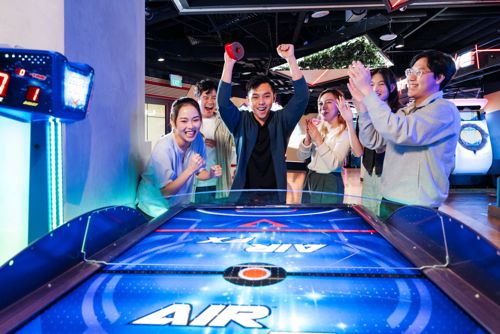
The lights, the sounds, the buzz of the arcade, your friends watching on — that's what makes winning at Timezone feel absolutely electric. Instead of feeling the pressure of being watched, channel it. Play to the atmosphere. Bring the energy up. And remember: a player who stays composed, keeps smiling, and keeps competing is always the most exciting person at the table — regardless of the score.
And even if the final score doesn't go your way? You're still winning at having a brilliant time — and that's what Timezone is all about!
Let the Games Begin at Timezone!
There you have it — 7 air hockey tips that cover everything from raw power and defensive geometry to reading your opponent and keeping your composure when the pressure is on. You've done the reading. Now it's time to put it all into practice.
And there's only one place to do that: Timezone! With dedicated air hockey tables, a vibrant arcade atmosphere, and the kind of energy that brings out the competitor in absolutely everyone, Timezone is the ultimate destination for kids and adults across Singapore. Available at all Timezone venues — gather the family, round up your crew, and see who comes out on top.
Load up your Timezone Powercard, step up to the table, and put every single one of these tips to the test. The puck is waiting — and so is your winning streak! Find your nearest air hockey table at Timezone here.


